Ultomiris Mechanism of Action ULTOMIRIS® (ravulizumab) targets uncontrolled terminal complement activity and delivers immediate, complete* and sustained C5 inhibition.1–3

PNH is a rare, chronic, life-threatening disease affecting the complement cascade – a critical part of the normal innate immune response.7 

Uncontrolled terminal complement activation impairs the normal functioning of blood cells and leads to life-threatening consequences such as IVH, thromboembolic events, renal impairment and pulmonary hypertension.6,8-10
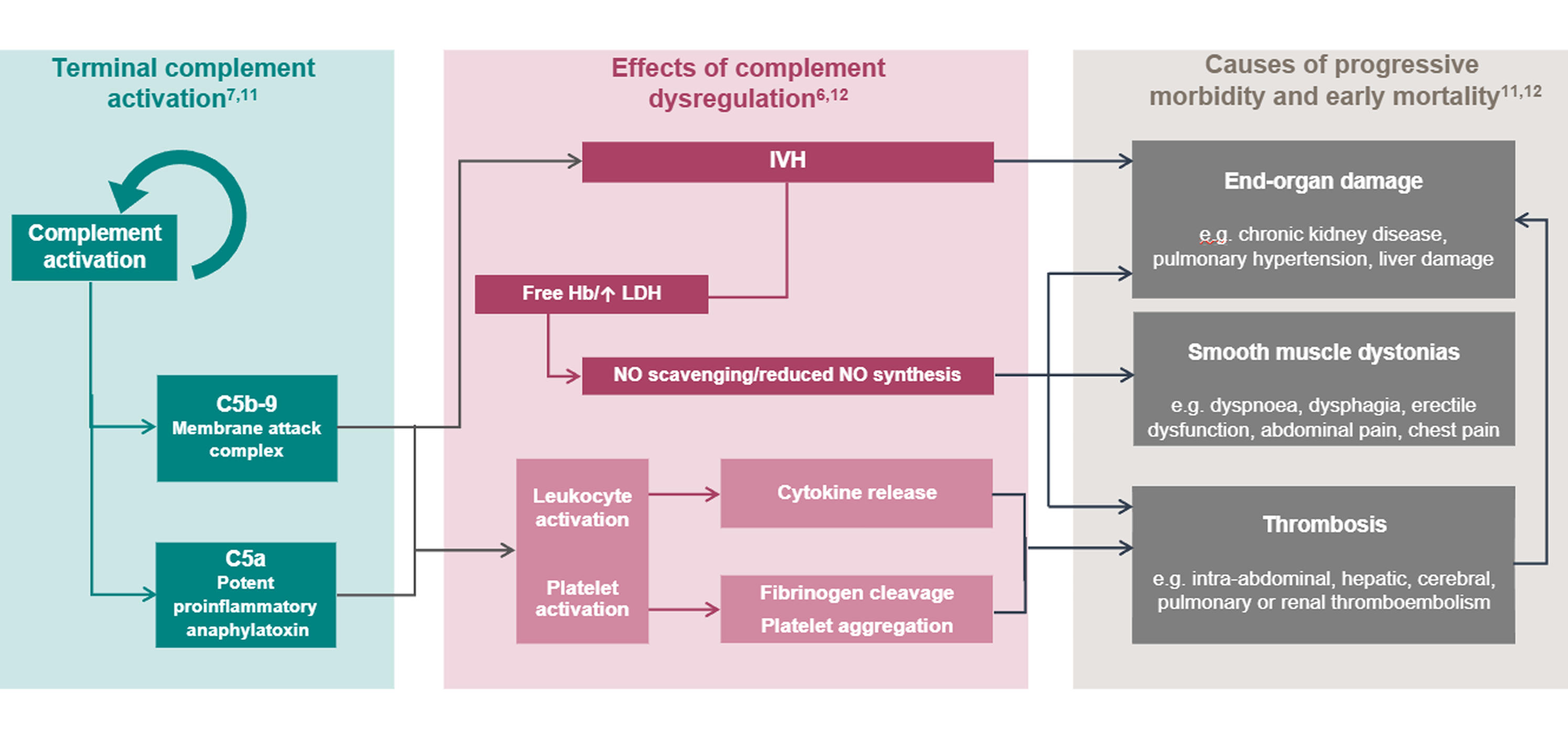
In IVH, red blood cells are destroyed within the bloodstream, releasing haemoglobin into plasma and causing life-threatening consequences such as thrombosis and organ damage.13–15 Elevated LDH level (≥1.5 x ULN) is a key biomarker for IVH.13-15 

If PNH is left untreated, it can lead to early mortality.4,16 Thrombosis is a leading cause of death, occurring in 40-67% of patients, and can be fatal at the first event.17,18

Before the availability of today’s standard of care of C5 inhibitors, ~35% of patients died within 5 years.‡16,19

*Complete C5 inhibition is defined as serum free C5 concentration <0.5 μg/mL.2,3

Percentages listed are from various studies, and many do not account for racial variance.17,18

Based on the natural history study of 80 patients with PNH in London, UK, between 1940–1970 who were followed for up to 48 years after diagnosis.19


Media Media Media Media

ULTOMIRIS® achieved complete terminal complement inhibition (serum free C5 <0.5 μg/mL) by the end of the first infusion. Furthermore, C5 inhibition with ULTOMIRIS® is long-acting and is sustained throughout the 8-week dosing interval.1–3 In this way, ULTOMIRIS® delivers the complete and sustained blockade of terminal complement required for disease control while allowing the proximal function of the complement system to remain intact to clear pathogens.1-3,14

Sustained PNH disease control with ULTOMIRIS® reduces the risk of life-threatening IVH and thrombosis.2,3

ULTOMIRIS® Study Design
Please report any adverse events via your national reporting system. Adverse events can also be reported to Alexion, AstraZeneca Rare Disease by contacting: https://contactazmedical.astrazeneca.com/
FcRn, neonatal Fc receptor; Hb, haemoglobin; HSCT, hematopoietic stem cell transplant; IVH, intravascular haemolysis; LDH, lactose dehydrogenase; NO, nitrous oxide; OLE, open-label extension; PNH, paroxysmal nocturnal haemoglobinuria; ULN, upper limit of normal; C5, complement component 5.
ULTOMIRIS® EU Summary of Product Characteristics available at: https://www.ema.europa.eu/en/documents/product-information/ultomiris-epar-product-information_en.pdf. Last accessed January 2026. Lee JW, et al. Ravulizumab (ALXN1210) vs eculizumab in adult patients with PNH naive to complement inhibitors: the 301 study. Blood. 2019;6(133):530–539. Kulasekararaj AG, et al. Ravulizumab (ALXN1210) vs eculizumab in C5-inhibitor–experienced adult patients with PNH: the 302 study. Blood. 2019;6(133):540–549. Brodsky RA. Paroxysmal nocturnal hemoglobinuria. Blood. 2014;18(124):2804–2811. Risitano AM, et al. The complement alternative pathway in paroxysmal nocturnal hemoglobinuria: From a pathogenic mechanism to a therapeutic target. Immunology Review. 2023;313:262–278. Hill A, et al. Thrombosis in paroxysmal nocturnal hemoglobinuria. Blood. 2013;25(121):4985–4996. Lee JW, et al. The role of the alternative pathway in paroxysmal nocturnal hemoglobinuria and emerging treatments. Expert Review of Clinical Pharmacology. 2022;7(15):851–861. Van Bijnen ST, et al. Mechanisms and clinical implications of thrombosis in paroxysmal nocturnal hemoglobinuria. Journal of Thrombosis Haemostasis. 2012;1(10):1–10. Risitano AM, Rotoli B. Paroxysmal nocturnal hemoglobinuria: pathophysiology, natural history and treatment options in the era of biological agents. Biologics. 2008;2(2):205–222. Szlendak U, et al. Paroxysmal nocturnal hemoglobinuria: advances in the understanding of pathophysiology, diagnosis, and treatment. Review Article 2022. Kelly R, et al. The pathophysiology of paroxysmal nocturnal hemoglobinuria and treatment with eculizumab. Therapeutics and Clinical Risk Management. 2009;5:S911–921. Hill A, et al. Paroxysmal nocturnal haemoglobinuria. Nature Reviews Disease Primer. 2017. Risitano AM, et al. Anti-complement Treatment for Paroxysmal Nocturnal Hemoglobinuria: Time for Proximal Complement Inhibition? A Position Paper From the SAAWP of the EBMT. Frontiers in Immunology. 2019;10:1157. Kulasekararaj AG, et al. The importance of terminal complement inhibition in paroxysmal nocturnal hemoglobinuria. Therapeutic Advances in Hematology. 2022;(13):20406207221091046. Lee JW, et al. Clinical signs and symptoms associated with increased risk for thrombosis in patients with paroxysmal nocturnal hemoglobinuria from a Korean Registry. International Journal of Hematology. 2019;6(97):749–757. Sharma VR, et al. Paroxysmal nocturnal hemoglobinuria: pathogenesis, testing, and diagnosis. Clinical Advances in Hematology & Oncology. 2013;9(11 Suppl 13):2–8. Schrezenmeier H, et al. Assessing risk of thrombosis in Paroxysmal Nocturnal Hemoglobinuria: Time for Proximal Complement Inhibition? Frontiers in Immunology. 2019;10:1157. Hillmen P, Muus P, Dührsen U, et al. Effect of the complement inhibitor eculizumab on thromboembolism in patients with paroxysmal nocturnal hemoglobinuria. Blood. 2007;110(12):4123–4128. Hillmen P, et al. Natural History of Paroxysmal Nocturnal Hemoglobinuria. New England Journal of Medicine. 1995;19(333):1253–1258. Kearon C. Natural history of venous thromboembolism. Circulation. 2003;23 Suppl 1(107):I22–I30. Sheridan D, et al. Design and preclinical characterization of ALXN1210: A novel anti-C5 antibody with extended duration of action. PLoS One. 2018;13(4):e0195909. SOLIRIS®EU Summary of Product Characteristics available at: https://www.ema.europa.eu/en/documents/product-information/soliris-epar-product-information_en.pdf. Last accessed January 2026.