

Strensiq logo About STRENSIQ® STRENSIQ® (asfotase alfa) is indicated for long-term enzyme replacement therapy in patients with paediatric-onset hypophosphatasia (HPP) to treat the bone manifestations of the disease.1 To date, this is the first and only approved treatment in this indication,2–4 supported by up to 7 years of clinical data.2,5–7

This medicinal product is subject to additional monitoring. This will allow quick identification of new safety information. Please report any adverse events via your national reporting system. Adverse events can also be reported to Alexion Pharmaceuticals by contacting:
https://contactazmedical.astrazeneca.com.
Please refer to the Summary of Product Characteristics for further information.

advance I am a healthcare professional registered in the EU I am not a
healthcare professional
Icon of a syringe next to a medicine bottle Icon of a damaged bone Icon of a person walking Icon of a prescription pad
HPP is characterised by persistently low ALP activity, impaired bone mineralisation, muscle weakness and other systemic manifestations.8–10
  • HPP is caused by deficient activity of an enzyme, TNSALP, which is encoded by the ALPL gene8–11*
* Different isoforms of ALP exist; however the majority is TNSALP.11,12
The clinical presentation of HPP can differ in its signs and symptoms.8–10
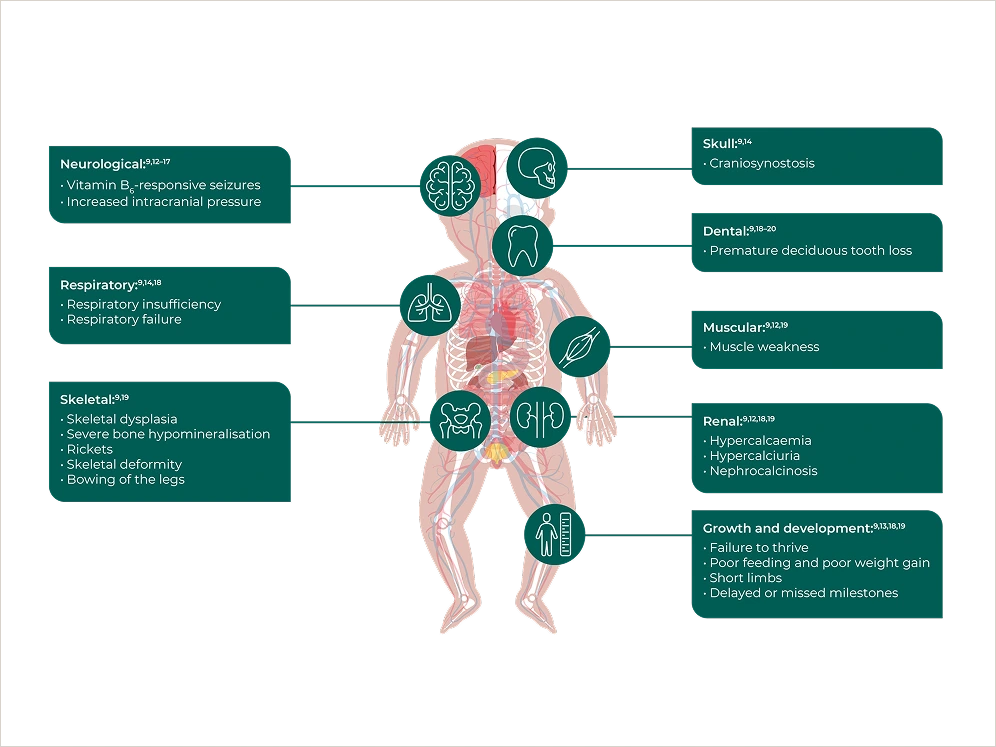
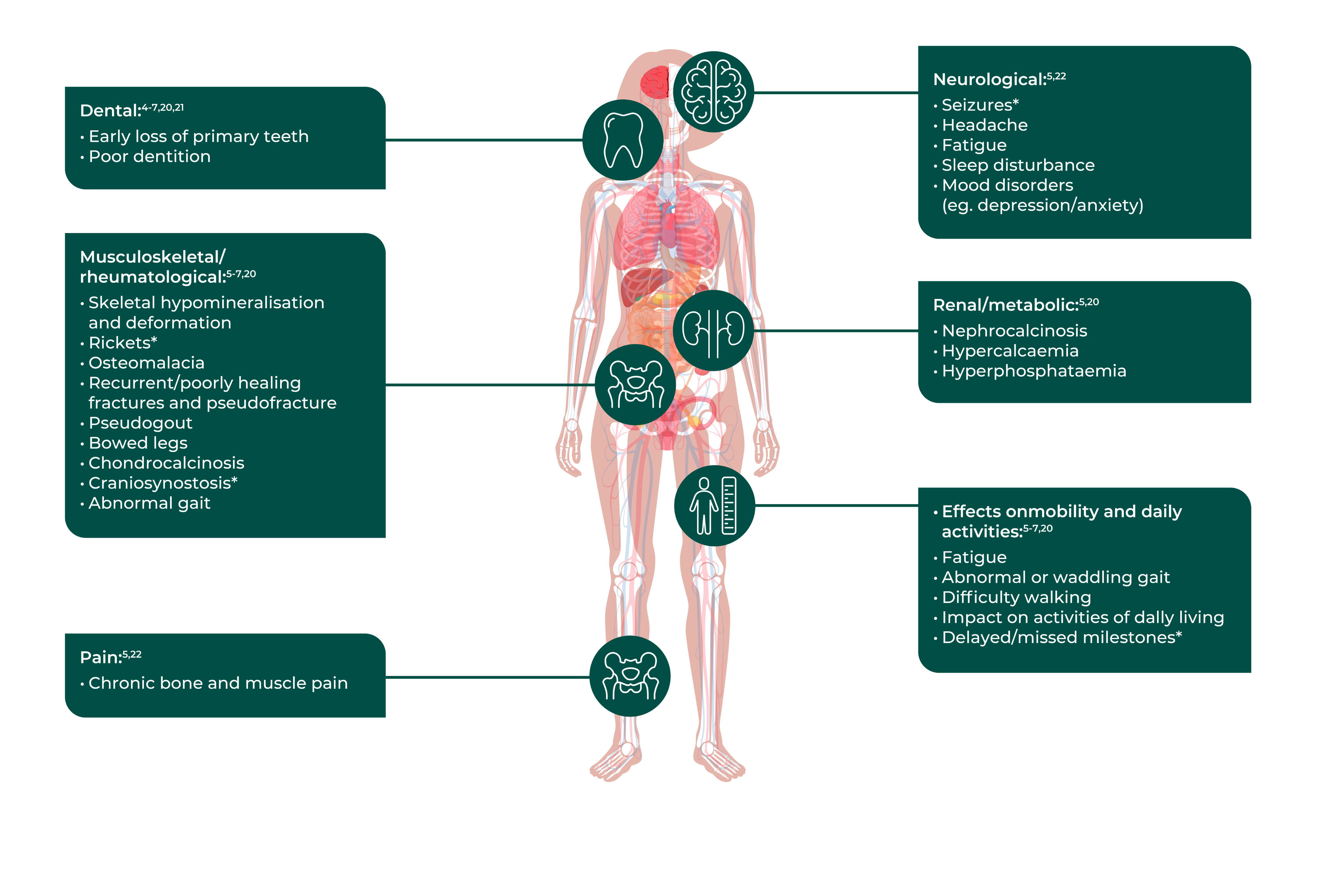
This list is not exhaustive. Disease may manifest differently in adults and children.

* Indicates manifestations typical in children. All other manifestations occur in both children and adults.
Mortality is high in perinatal and infantile-onset populations, primarily as a result of respiratory failure and/or other complications due to impaired bone mineralisation and chest deformity.19,22

Pain, dental problems, skeletal, constitutional/metabolic, and muscular manifestations were most frequently reported

Icon of a damaged bone

67.3% (n/N=202/300) of adult patients reported pain, 30.2% (n/N=79/262) received medication for pain, 11.8% (n/N=31/262) reported taking opioids
Icon of a pill

62.1% (n/N=149/240) had a history of ≥ 1 fracture/pseudo-fracture and 37.8% (n/N=102/270) of patients experienced ≥ 5 HPP manifestations, highlighting that HPP is a systemic disease with wide-ranging effects
Icon of a damaged bone

Surgical intervention was required for 28.2% (n/N=42/149) of those patients who had ≥ 1 fracture/pseudo-fracture before treatment, and 54.3% (n/N=163/300) reported early loss of deciduous teeth, loss of permanent teeth and poor dentition

Icon of a tooth

Of those who reported to use ≥ 1 assistive device for disability or home modification, assistive devices in use were crutches (39.0%) and a cane (34.1%); home modifications were widely reported

Icon of crutches
* As seen in the Global HPP Registry, an observational, longitudinal, multinational long-term study collecting data on HPP diagnosis, history, clinical course, symptoms (including multisystemic aspects of disease) and burden of illness from patients who have a diagnosis of HPP. 304 adults with a confirmed diagnosis of HPP who met the analysis criteria were included within this analysis.24

Including early loss of deciduous teeth, loss of permanent teeth and poor dentition.24

Of those with available data.24
Discover more
ALP, alkaline phosphatase; HPP, hypophosphatasia; TNSALP, tissue non-specific alkaline phosphatase.
This medicinal product has been authorised under ‘exceptional circumstances’. This means that due to the rarity of the disease it has not been possible to obtain complete information on this medicinal product.

▼This medicinal product is subject to additional monitoring. This will allow quick identification of new safety information. Please report any adverse events via your national reporting system. Adverse events can also be reported to Alexion Pharmaceuticals by the following link: https://contactazmedical.astrazeneca.com/
STRENSIQ® Summary of Product Characteristics. Alexion Europe SAS. Available at https://www.ema.europa.eu/en/documents/product-information/strensiq-epar-product-information_en.pdf. Last accessed: June 2025. Whyte MP, et al. Asfotase alfa for infants and young children with hypophosphatasia: 7 year outcomes of a single-arm, open-label, phase 2 extension trial. Lancet Diabetes Endocrinol. 2019;7(2):93–105. European Medicines Agency. EPAR for Strensiq. 2024. Available at: https://www.ema.europa.eu/en/medicines/human/EPAR/strensiq#product-info. Last accessed: June 2025. Jaswanthi N, et al. Effect of Asfotase Alfa in the Treatment of Hypophosphatasia- A Systematic Review. J Pharm Bioallied Sci.2023;15(Suppl 1):S101-S104. Hofmann CE, et al. Efficacy and Safety of Asfotase Alfa in Infants and Young Children With Hypophosphatasia: A Phase 2 Open-Label Study. J Clin Endocrinol Metab. 2019;104(7):2735–2747. Whyte MP, et al. Asfotase alfa therapy for children with hypophosphatasia. JCI Insight. 2016;1(9):e85971. Kishnani PS, et al. Five-year efficacy and safety of asfotase alfa therapy for adults and adolescents with hypophosphatasia. Bone. 2019;121:149–162. Brandi ML, et al. The challenge of hypophosphatasia diagnosis in adults: results from the HPP International Working Group Literature Surveillance. Osteoporos Int. 2024;35(3):439-449. Khan AA, et al. Hypophosphatasia diagnosis: current state of the art and proposed diagnostic criteria for children and adults. Osteoporos Int. 2023;35:431–438. Rush E, et al Proposed diagnostic criteria for the diagnosis of hypophosphatasia in children and adolescents: results from the HPP International Working Group. Osteoporos Int. 2024;35:1–10. Whyte MP. Hypophosphatasia: nature’s window on alkaline phosphatase function in humans. In: Bilezikian JP, Raisz LG, Martin TJ, eds. Principles of Bone Biology. Vol 1. 3rd ed. San Diego, CA: Academic Press; 2008:1573-1598. Fenn JS, et al. Hypophosphatasia. J Clin Pathol.2021;71(10):635–640. Bishop N, et al. Transformative therapy in hypophosphatasia. Arch Dis Child. 2016;101:514–515. Leung EC, et al. Outcome of perinatal hypophosphatasia in manitoba mennonites: a retrospective cohort analysis. JIMD Rep. 2013;11:73–78. Mohn A, et al. Hypophosphatasia in a child with widened anterior fontanelle: lessons learned from late diagnosis and incorrect treatment. Acta Paediatr. 2011;100:e43–e46. Surtees R, et al. Inborn errors affecting vitamin B6 metabolism. Future Neurol. 2006;1:615–620. Collmann H, et al. Neurosurgical aspects of childhood hypophosphatasia. Childs Nerv Syst. 2009;25:217–223. Bangura A, et al. Hypophosphatasia: Current Literature for Pathophysiology, Clinical Manifestations, Diagnosis, and Treatment. Cureus. 2020;12(6):e8594. Rockman-Greenberg C. Hypophosphatasia. Pediatr Endocrinol Rev. 2013;10(suppl 2):380–388. Bloch-Zupan A. Hypophosphatasia: diagnosis and clinical signs - a dental surgeon perspective. Int J Paediatr Dent. 2016;26:426–438. Hogler W, Langman C, Gomes da Silva H, et al. Diagnostic delay is common among patients with hypophosphatasia: initial findings from a longitudinal, prospective, global registry. BMC Musculoskelet Disord. 2019;20 (1):80. Szabo, S.M., Tomazos, I.C., Petryk, A. et al. Frequency and age at occurrence of clinical manifestations of disease in patients with hypophosphatasia: a systematic literature review. Orphanet J Rare Dis 14, 85 (2019). Rush ET, et al. Burden of disease in pediatric patients with hypophosphatasia: results from the HPP Impact Patient Survey and the HPP Outcomes Study Telephone interview. OJRD. 2019;14:201. Seefried L, et al. Burden of Illness in Adults With Hypophosphatasia: Data From the Global Hypophosphatasia Patient Registry. J Bone Miner Res. 2020;35(11):2171–2178.